Rules to perform mathematical operations
Addition and subtraction/Addition and subtraction
Multiplication and division/Multiplication and division
Uncertainty and errors
Errors

Rules to perform mathematical operations
Addition and subtraction/Addition and subtraction
Multiplication and division/Multiplication and division
Uncertainty and errors
Errors
After distance and displacement that we have seen earlier, I am now going to talk about speed and velocity. They are quite different and to understand them it is important to understand clearly the difference distance and displacement before going forward.
Speed
Speed is a scalar quantity and the unit is the metre per second (m s-1)
A boy moves from point A and walks a distance of 50 m to the point B in a time of 20 s.
Firstly what is the distance travelled in 1 second?
Yes the boy would walk a distance of 2.5 m in a time of 1 second.
The distance travelled in a time of 1 second is called the speed.
The equation to calculate the speed is shown below.
Can you determine the speed of the boy?
Hence whenever speed is calculated the distance should be used.
Velocity
Velocity is a vector quantity and the unit is also the metre per second(m s-1)
Since it is a vector quantity then when it is determined direction is important and hence displacement should be used.
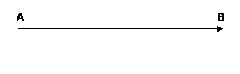
A boy moves from point A to point B performing a displacement of 50 m towards the right as shown in the diagram below.
The following equation is used to determine the velocity.
Hence the velocity of the boy can be calculated as shown below.
Please note the difference between the two. For the speed the distance travelled is used while for the velocity the displacement is used.
Power is the rate of doing work.
From the definition we can deduce the following equation
Power = Work done /Time taken
The unit of power is the Watt (symbol W) or the Joule/second (J/s)
Example 1
A boy pushes a box and as a result does 120 J of work in 10 s. What is the power developed by the boy?
Power = Work done / time taken
= 120 /10
= 12 W or J/s
There is another definition for power that is often used. It is
Power is the rate of dissipation of energy or the rate of change of energy conversion.
Power = Energy dissipated / Time taken
Example 2
A girl climbs a staircase gaining 500 J of gravitational potential energy in 10 s.
What is the power developed by the girl?
Power = Energy conversion / Time taken
= 500 / 10
= 50 W or J/s
Example 3
During the boiling of some water 4000 J of heat energy is dissipated in the kettle’s heater in a time of 8 s. What is the power of the heater?
Power = Energy dissipated/Time taken
= 4000/8
= 500 W or J/s
It is now time to do some questions. It will give these questions after a few of you have supplied your answers.
1. A trains of mass 50000 kg accelerated form rest and reaches a velocity of 50 ms-1 in 60 s.
(a) Calculate the kinetic energy gained by the train.
(b) Calculate the power of the train engine.
2. A lamp is rated 80 W. If it is switched on for two hours, how much light energy is dissipated.
Physical quantities
What is a physical quantities?
Subject of formula
Subject of formula: The basics
Vectors
What is a vector and how to add vector
How to subtract one vector from another
Units
Base Units
Derived units
Prefixes
Measurement of physical quantities
Volume and volume of irregular objects
Prefixes


![clip_image002[6]](https://blogger.googleusercontent.com/img/b/R29vZ2xl/AVvXsEj0nKFvSAk6o6CJzFhfaf3WoEx7wTzF0yQg5N1jiUdPn6rH0FYMnA0_jTZsj5oL8pvueGozmzg40puHPMxM2V6V-WrrFDYPjwRVZ0K55DPZ2wtcU8_Sgr6topR8bWvTAD29cFIKHC0YKVLx/s1600-h/clip_image00262.gif "clip_image002[6]")
![clip_image002[8]](https://blogger.googleusercontent.com/img/b/R29vZ2xl/AVvXsEgDASKEizUs0IBFaSJ5FFx5h9wzGDFnd4BZWytnUZyJZ1vnkDKv3ozeAMsdLxHR8zl1WHwITjP7IX5QQ0LDOQCeg3QtiUNv8_eNpWRBeihIdNZDWxT8y_D_cCUwFuaZzUSouM4qgcKGMahu/s1600-h/clip_image00282.gif "clip_image002[8]")
![clip_image002[12]](https://blogger.googleusercontent.com/img/b/R29vZ2xl/AVvXsEhyly5V2RHvh9uH9HLcvuAOJujhn-UeWexSe6Zaz1Da8KTOz4f5TpaBT-vT8goPeHoCq6yMrSVRNFw-S9c1DL9Yx-AwDmTwYFiQ6nIOsj3_zfLPaKZozSkp6dO4cQf1W7VYEhtpz72Rq98v/s1600-h/clip_image002124.gif "clip_image002[12]")