After distance and displacement that we have seen earlier, I am now going to talk about speed and velocity. They are quite different and to understand them it is important to understand clearly the difference distance and displacement before going forward.
Speed
Speed is a scalar quantity and the unit is the metre per second (m s-1)
A boy moves from point A and walks a distance of 50 m to the point B in a time of 20 s.
Firstly what is the distance travelled in 1 second?
Yes the boy would walk a distance of 2.5 m in a time of 1 second.
The distance travelled in a time of 1 second is called the speed.
The equation to calculate the speed is shown below.
Can you determine the speed of the boy?
Hence whenever speed is calculated the distance should be used.
Velocity
Velocity is a vector quantity and the unit is also the metre per second(m s-1)
Since it is a vector quantity then when it is determined direction is important and hence displacement should be used.
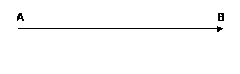
A boy moves from point A to point B performing a displacement of 50 m towards the right as shown in the diagram below.
The following equation is used to determine the velocity.
Hence the velocity of the boy can be calculated as shown below.
Please note the difference between the two. For the speed the distance travelled is used while for the velocity the displacement is used.
As we have seen in the last post there are 7 fundamental base units. From these 7 fundamental base units all the other units can be derived.
In fact if a quantity is not a basic quantity then it must certainly be a derived quantity and its unit a derived unit. The derived unit is based on one or more of the 8 fundamental base units. You must keep in mind that some quantities have units of their own based on famous scientists such as Joule (J) for energy or Newton (N) for force. For such quantities the unit can be used or the derived unit can be used.
We are now going to see several derived quantities and their derived units and how these derived units are obtained.
We are now going to see how these derived units are obtained. Once you know how to determine the derived units of common quantities like volume, force, etc then later on you will be able to determine the derived quantity for any other quantity.
So what is the method to obtain the derived unit of a quantity?
Example 1
We are going to start with a simple one: the derived unit for volume.
In order to deduce the derived unit of a quantity you need a formula to calculate the quantity. The formula must contain that you know the units in term of based unit.
Volume = length * width * height
Unit of [volume] = unit of [length * width * height]
= unit of [length] * unit of [width] * unit of [height]
= m * m *m
= m3
Example 2
What is the derived unit for acceleration?
In order to deduce the derived unit for acceleration, you must know a formula to calculate acceleration such as
Acceleration = velocity / time
The formula must contain quantities that you know the units in term of base units.
If in the new formula, there is quantity that you do not know the derived unit then you will also have to know the formula to calculate that quantity.
Velocity = displacement / time
You can now rewrite the formula for acceleration to
Acceleration = velocity / time
= (displacement / time) /time
So
the unit of acceleration = unit of [velocity / time]
= unit of [(displacement / time) /time]
= unit of [(displacement / time)] / unit of time
= (m/s) /s
= m *s-1 * s-1 = m s-2
Was it easy?
Now let us have a look at another example to confirm your newly learned skills.
Example 3
What is the derived unit for pressure?
Have you worked it out?
Now you would remember that in order to find the derived unit you need to know a formula for the quantity in term of quantities that you already know the units.
Pressure = Force / surface are
Hence unit of pressure = unit of [force] / unit of [surface area]
= unit of [mass * acceleration] / unit of surface area]
= (kg * m/ s2)/m2 = (kg m * s-2 * m -2 = Kg m-1 s-2
Do the following questions and post the answers in the comment section. I will give the correct answers later on after a few of you have submitted your answers.
Find the derived units for the following quantities.
1. Work done
2. Kinetic energy
3. Volume
4. Density
As you progress through the course you will meet more quantities that you would be able to derive the units.
Units are the third aspect that is important when measuring in Physics. It can be the mistake that will ruin the whole measurement process.
Let us recap.
You need to identify the quantity that is to be measured eg length of the book.
you need to use the correct instrument to measure the quantity. In this case the 30 cm ruler.
Lastly you need to measure the length and write it with appropriate unit.
Imagine that you write the length of a 20 cm long book as 20 inches. Then it ruins the whole measurement process.
SI units
To avoid such mistakes scientist around the world have decided to use what is called the SI system of units. It is a standard that is used by all scientists such that when a particular quantity is being measures everyone uses the same units although the Americans and the British continue to use the old systems. This has resulted in costly mistakes and loss of human lives in the space industry.
Base units
The SI system is based on fundamental base units on which all other units can be derived.
The 7 fundamental base units are given in the table below.
Basic Quantity
Base unit
Symbol of base unit
Length
Metre
m
Time
Second
s
Mass
Kilogram
kg
Thermodynamic temperature
Kelvin
K
Luminous intensity
Candela
Cd
Electric current
Ampere
A
Amount of matter
Mole
Mol
These units are the 7 fundamental base units that are used in the SI system of units. Hence even though the quantities in the above table can be measured using other units, it is recommended that only these units are used.
The next part this series on derived units can be found here.


![clip_image002[6]](https://blogger.googleusercontent.com/img/b/R29vZ2xl/AVvXsEj0nKFvSAk6o6CJzFhfaf3WoEx7wTzF0yQg5N1jiUdPn6rH0FYMnA0_jTZsj5oL8pvueGozmzg40puHPMxM2V6V-WrrFDYPjwRVZ0K55DPZ2wtcU8_Sgr6topR8bWvTAD29cFIKHC0YKVLx/s1600-h/clip_image00262.gif "clip_image002[6]")
![clip_image002[8]](https://blogger.googleusercontent.com/img/b/R29vZ2xl/AVvXsEgDASKEizUs0IBFaSJ5FFx5h9wzGDFnd4BZWytnUZyJZ1vnkDKv3ozeAMsdLxHR8zl1WHwITjP7IX5QQ0LDOQCeg3QtiUNv8_eNpWRBeihIdNZDWxT8y_D_cCUwFuaZzUSouM4qgcKGMahu/s1600-h/clip_image00282.gif "clip_image002[8]")
![clip_image002[12]](https://blogger.googleusercontent.com/img/b/R29vZ2xl/AVvXsEhyly5V2RHvh9uH9HLcvuAOJujhn-UeWexSe6Zaz1Da8KTOz4f5TpaBT-vT8goPeHoCq6yMrSVRNFw-S9c1DL9Yx-AwDmTwYFiQ6nIOsj3_zfLPaKZozSkp6dO4cQf1W7VYEhtpz72Rq98v/s1600-h/clip_image002124.gif "clip_image002[12]")


