Custom Search
If you want to discuss more on this or other issues related to Physics, feel free to leave a message on my Facebook page.

Tuesday, November 24, 2009

Speed and velocity

After distance and displacement that we have seen earlier, I am now going to talk about speed and velocity. They are quite different and to understand them it is important to understand clearly the difference distance and displacement before going forward.


Speed

Speed is a scalar quantity and the unit is the metre per second (m s-1)

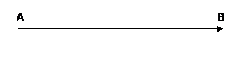
A boy moves from point A and walks a distance of 50 m to the point B in a time of 20 s.

clip_image00111_thumb1

Firstly what is the distance travelled in 1 second?

Yes the boy would walk a distance of 2.5 m in a time of 1 second.

The distance travelled in a time of 1 second is called the speed.

The equation to calculate the speed is shown below.

clip_image002


Can you determine the speed of the boy?

clip_image002[6]

Hence whenever speed is calculated the distance should be used.

Velocity

Velocity is a vector quantity and the unit is also the metre per second(m s-1)

Since it is a vector quantity then when it is determined direction is important and hence displacement should be used.

A boy moves from point A to point B performing a displacement of 50 m towards the right as shown in the diagram below.

clip_image00121_thumb

The following equation is used to determine the velocity.

clip_image002[8]

Hence the velocity of the boy can be calculated as shown below.

clip_image002[12]

Please note the difference between the two. For the speed the distance travelled is used while for the velocity the displacement is used.

Distance and displacement

Distance and displacement are two quantities that are used to describe motion. We are going to have a look at both of them and see how to differentiate between the two.

Distance

Distance is a scalar quantity and the SI unit is the Metre (m)

Example 1

clip_image001[11]


Now suppose a person moves from an initial position of A and travels to a final position of B. The line connecting the two points is the path that the person would take. Now the distance travelled is the length of the path taken by the person from the initial position to the final position.

Example 2

clip_image001[9]

Now if the path is not a straight line like in the diagram shown above then the distance travelled is the length of the path  from A to B through all the turns  as measured with a measuring tape.

Example 3

clip_image001[19]

The next example is shown above. The person moves from A to D. The path is a line moving from A to B to C and then finally to D. Then the distance travelled is the length of the path AB+ the length of the path BC + the length of the path CD

Displacement

Displacement is a vector quantity and the SI unit is the metre (m)

The displacement is a vector representing the shortest path from the initial position to the final position. It is thus a vector quantity. Let us have a look at the different motion above and see how the displacement is determined and how it is different from the distance.

Example 4

As we have seen in example 1 above the person moves from the initial position A to the final position B.

clip_image001[21]

As you can see the person moves from the initial position A to the final position B and the vector representing this motion is as shown. And the displacement is represented by this vector. Hence the displacement will have both a magnitude which would be the length of the vector and a direction which would be the direction of the vector.

For example 4 above we can say that the displacement is 10 m to the east.

Displacement = 10 m to the east

or Displacement = 10 m to the right

As you can see the displacement would have both a magnitude and a direction since it is a vector quantity.

Example 5

clip_image001[25]

This is the same motion that we used in example 2. The person moves from the initial position A and travels until he reaches the final position B. As you can see on the diagram above there is a vector from the initial position A to the final position B. This vector represent the displacement of the person where the length of the vector is its magnitude and the direction of the vector the direction of the displacement.

In this case the displacement of the person can be said to be

Displacement = 10 m 15o clockwise from the horizontal,

Where the line AC represent the easterly direction,

Example 6

Now let us look at the same motion example that the person did in example 3. The person walks from A to B to C and finally arrives at D. You can see on the diagram below that I have drawn a vector AD that starts from the point A and ends at the point D. This vector is the displacement vector and as you can see it has a magnitude and a direction.

We can say for example that the displacement is as shown

Displacement = 15 m 150 clockwise from the horizontal

clip_image001[6]

As you have seen displacement and distance are two quantities easy to understand and to differentiate but as usual if you have any question you can leave them here and I would answer then as soon as possible.

Saturday, November 21, 2009

How to determine uncertainty in a derived quantity when powers, root,etc are involved.

As we have seen in the first two part of this series it is easier to determine the uncertainty when addition and subtraction is involved but also to determine uncertainty when multiplication and division is involved.

Today we are going to see how to determine the uncertainty when a power is involved.

Very often a derived quantity is determined basic or othere derived quantities using powers, roots, etc.

For example

image 

image

As we are going to see the method to determine the uncertainty in these three cases are similar and can be adapted to other derived quantities.

Example

Let us have a look at how to determine the uncertainty in volume.

A cube has length of L = 20.4+_0.2cm

Determine the uncertainty in volume.

clip_image002

V = L3

V = L*L*L

clip_image002[4]

clip_image002[8]

clip_image002[10]

clip_image002[12]

clip_image002[14]

=249 = 200 (1 sf because of 0.2 )

V = L3

=20.43

=8489

=8500 (2 sf because of 200)

Hence V = 8500+_200 cm3

After you have studied this example are you able to know how to find the uncertainty in any other derived quantities?

If clip_image002[22]

Then the fractional uncertainty is clip_image004[8]

What if area clip_image006[6]

Then can you deduce the fractional uncertainty?

Yes it is clip_image008[6]

Can you deduce what would be the fractional uncertainty ifclip_image010[6]?

Yes it is clip_image012[6])

Lastly you deduce the fractional uncertainty if clip_image014?

Where K is a dimensionless constant with no uncertainty.

Yes it is also clip_image012[7])

When there is a dimensionless constant with no uncertainty it does not enter in the equation to calculate the fractional uncertainty.

Question

The area of a circle is given by the equation

clip_image002[26]

If the radius r =10.1+_0.5 cm

then calculate the fractional uncertainty and the uncertainty in A.

Please not that clip_image002[28]is a dimentionless constant with no uncertainty and hence will play no part in thecalculations.

Sunday, November 15, 2009

Force, work, power and energy

Newton’s first law of motion

Newton’s second law of motion 

Weight of an object

Work done

Kinetic energy

Gravitational Potential energy

Gravitational potential energy to kinetic energy and vice versa

Power

Tuesday, October 13, 2009

Gravitational potential energy to kinetic energy and vice versa.


As we have seen in earlier post an object can have either gravitational potential energy or kinetic energy. However it is always possible for the object to have both kinetic energy and gravitational potential energy. Think of a plane flying at a certain height above the ground.

It is going to have kinetic energy due to its speed and gravitational potential energy due to its height.

Now what happens to a body that is either falling toward the ground or rising to a certain height. 

body moving up and down

As you can see in fig 1 the object is rising and as a result its height is also rising, hence its potential energy is also increasing. Its kinetic energy is however decreasing. (see Principle of conservation of energy).

However the object in fig 2 is falling towards the ground. Since its height is decreasing, its gravitational potential energy must also be decreasing and its kinetic energy increasing.

Example 1

potential to kinetic energy

In this example a ball is released from rest from a height h.

If the ball is initially at rest then

v = 0  ms-1 hence Ek = 0 J

However since the object is at a height h the Ep = mgh

When the ball is released it fall under the effect of the force of gravity, as a result it will accelerate downward and as a result the velocity of the object will increase  while the height of the object decreases.

Hence as the velocity decreases the kinetic energy decreases while the gravitational potential energy decreases as the height decreases.

However at all time    Ek +  Ep = Total energy and total energy is constant.

As the object reaches the ground the height becomes zero so does the gravitational potential energy while the kinetic energy reaches its maximum value. At this point all the gravitational potential energy would have been converted to kinetic energy.

When it reaches the ground h = 0 m hence Ep = 0 J

While Ek = 0.5 mv2

Example 1

A man of mass 64 kg jumps from a bridge 25 m high into a river.

(a) Calculate the gravitational potential energy of the man when he is on the bridge.

(b) What is his speed of entry into the water.

Now the man is on the bridge at a height of 25 m. It means that he has gravitational potential energy.

(a)  Gravitational potential energy Ep = mgh

                                                                = 64*9.81*25

                                                                = 15696J

                                                                 = 1.5 *104J                                        

(b) When the person jumps the gravitational potential energy decreases as his height decreases. However as the person fall to the ground his speed increases and as a result the kinetic energy is completely converted to kinetic energy.

Hence what he reaches the river all the gravitational potential energy has been converted to kinetic energy.

Kinetic energy at surface of river =  1.5 *104J

Ek = 0.5 mv2

1.5 *104= 0.5 *64*v2

v = (1.5 *104/0.5/64)0.5

    = 21.65 m s-1

=22 m s-1

It is now time for a question. I will give you an answer to do. I will give the answer when some of you have given the answers.

Good luck.

A girl of mass 50 kg is trying to jump over a bar. She ran at a speed of and leaves the ground and successfully jumped over the bar.

(a) Calculate the kinetic energy that she has when she is running.

(b) Deduce the gravitational potential energy of the girl when she is at her maximum height.

(c) Calculate the height of the bar.

Monday, October 5, 2009

How to determine uncertainty in derived quantity when multiplication or division is performed

This is the second part of a series of post on finding uncertainty in derived quantities. You can find the index here and the part on addition and subtraction here.

Now very often when you performed an experiment you meet quantities that need to be processed to obtain a derived quantity such as g, the acceleration due to gravity, or any other derived quantities.

You have already seen the first part on addition and subtraction and now you will see how to do it for multiplication and division.

If in an experiment is performed and the following quantities are measured with their uncertainties.

A = 10.2+-0.2 cm

B = 5.4 +-0.4 cm

Now if you need to process these quantities to find AB and A/B with their uncertainties how would you do it?

Uncertainty in multiplication

How would you determine the value of AB and its uncertainty?

You will have to calculate the value of AB first.

AB = 10.2 *5.4 = 55.o8 =55 (2 sf )

To determine the uncertainty in AB you will have to use the equation below.

formula for uncertainty multiplication

Rearranging the equation will give you

uncertainty in mutiplication

Hence AB = 55+-5 cm2

Remember the uncertainty in A and B are to 1 sf hence the uncertainty in AB must be given to 1 sf.

Uncertainty in division

You are now going to determine the value of A/B and its uncertainty.

You will have to determine the value of A/B first.

A/B = 10.2 /5.4 =1.888 = 1.9

To determine the uncertainty of A/B  you will determine the equation below

image

Rearranging the equation will give you

image

Remember the uncertainty in A/B is given to 1 sf since the uncertainties in A and B are given to 1 sf.

Hence A/B = 1.9 +-0.2

With these two formula you can thus determine the uncertainty in any derived quantities that involves multiplication and division.

Now you can move to the next part where the method to determine uncertainty of derived quantities where powers,  square root, etc are involved.

How to determine uncertainty in a derived quantity when addition or subtraction is performed?


As we have seen in the previous post it is important to know how to determine the uncertainty for derived quantities.

Let us see how to determine how to determine the uncertainty of a derived quantity when an addition or a subtraction is performed.

In an experiment two quantities are measured as shown.

A = 56.4 +_0.1 cm

B = 12.2+_0.1 cm

If a derived quantity C is given by the equation below

C = A + B

Then the uncertainty in C  deltaC = deltaA +deltaB

                    deltaC = 0.1 + 0.1

                       = o.2 cm

C = 56.4 + 12.2 = 68.6 cm

C = 68.6 +-0.2 cm

If you want to calculate C and the equation relating C to A and B is

C = A – B

Then we can use the following equation to calculate deltaC

deltaC = deltaA  +deltaB

Hence deltaC  = 0.1 + 0.1  = 0.2 cm

If C = 56.4 – 12.2 = 44.2 cm

then C = 44.2 +-0.2 cm

This is then end of this part. Please follow the link below to go to the part on determining the

Related Posts Plugin for WordPress, Blogger...