Custom Search
If you want to discuss more on this or other issues related to Physics, feel free to leave a message on my Facebook page.
Showing posts with label distance. Show all posts

Sunday, January 16, 2011

Second equation of motion

We have seen in a previous post the first equation of motion.

Today we are going to see the second equation of motion.

You would remember that the first equation dealt with acceleration, time taken, initial velocity and final velocity.

So how do we derive the second equation of motion?

Let us take an object that starts from an initial velocity u and then accelerates during a time t until it reaches a final velocity v.

Now during the time the object was accelerating the object has moved a distance s. In the second equation of motion we will try to derive the equation to calculate this distance s.

Fig 2 below shows what is happening to the object.

clip_image001[4]

Fig 1

Now you would remember that the area under a velocity-time graph is the distance travelled by the object. Hence we are going to calculate the area under the graph as indicated by the shaded area below.

clip_image001[6]

Fig 2

Now if s the distance travelled is the area under a velocity-time graph then we can say that

Area under graph = 1/2( v + u)*t

hence s = 1/2( v + u)*t

Now if you can remember the first equation of motion is

v = u +at

Hence if we replace v = u +at into s = 1/2( v + u)*t we get

s = 1/2( v + u)*t

s = 1/2( [u +at] + u)*t

s = 1/2( u + at + u)*t

s = 1/2(2 u + at )*t

s =1/2(2ut +at2)

S = ut + 1/2at2

Hence as you can see above the second equation of motion is

S = ut + 1/2at2

We are now going to look at two examples where the second equation of motion can be used.

Example 1

A bus starts from rest and accelerates at a rate of 2.5 m/s2 for a time of 50 s. Determine the distance travelled by the bus during the acceleration phase.

Now let us identify the different variables involved.

u the initial speed = 0 m/s

t time taken = 50 s

a acceleration = 2.5 m/s2

s distance travelled = ???

If we want calculate s the distance travelled we will have to use the second equation of motion

S = ut + 1/2at2

Substituting the different values we get

S = ut + 1/2at2

= o*50 + 0.5* 2.5*502

= 0 + 1.25*2500

=3125 m

Example 2

An aero plane travelling at a speed of 300 m/s lands on a track 2000 m long and decelerates for a time of 25 s until it comes to rest. Calculate the deceleration needed to stop the plane.

We must now identify the different variables involved as in the first example.

initial speed u = 300 m/s

time taken t = 25 s

Distance travelled s = 2000 m

acceleration a = ????

If we want calculate the acceleration a we will have to use the second equation of motion

S = ut + 1/2at2

and make a the subject of formula.

s – ut = 1/2at2

a =2(s - ut)/t2

= 2(2000 – 300*25)/252

= –8.8 m/s2

As you can see using the second equation of motion is not that difficult. Should you enter into any difficulties just post the question into the comment section.

Second equation of motion

We have seen in a previous post the first equation of motion.

Today we are going to see the second equation of motion.

You would remember that the first equation dealt with acceleration, time taken, initial velocity and final velocity.

So how do we derive the second equation of motion?

Let us take an object that starts from an initial velocity u and then accelerates during a time t until it reaches a final velocity v.

Now during the time the object was accelerating the object has moved a distance s. In the second equation of motion we will try to derive the equation to calculate this distance s.

Fig 2 below shows what is happening to the object.


clip_image001[4]

Fig 1

Now you would remember that the area under a velocity-time graph is the distance travelled by the object. Hence we are going to calculate the area under the graph as indicated by the shaded area below.

clip_image001[6]

Fig 2

Now if s the distance travelled is the area under a velocity-time graph then we can say that

Area under graph = 1/2( v + u)*t

hence s = 1/2( v + u)*t

Now if you can remember the first equation of motion is

v = u +at

Hence if we replace v = u +at  into s = 1/2( v + u)*t we get

s = 1/2( v + u)*t

s = 1/2( [u +at] + u)*t 

s = 1/2( u + at + u)*t

s = 1/2(2 u + at )*t

s =1/2(2ut +at2)

S = ut + 1/2at2

Hence as you can see above the second equation of motion is

S = ut + 1/2at2

 We are now going to look at two examples where the second equation of motion can be used.

Example 1

A bus starts from rest and accelerates at a rate of 2.5 m/s2 for a time of 50 s. Determine the distance travelled by the bus during the acceleration phase.

Now let us identify the different variables involved.

u the initial speed = 0 m/s

t time taken  = 50 s

a acceleration = 2.5 m/s2

s distance travelled = ???

If we want  calculate s the distance travelled we will have to use the second equation of motion

S = ut + 1/2at2

Substituting the different values we get

S = ut + 1/2at2

     = o*50 + 0.5* 2.5*502

      = 0 + 0.5*2500

     =3125 m

Example 2

An aero plane travelling at a speed of 300 m/s lands on a track 2000 m long and decelerates  for a time of 25  s until it comes to rest. Calculate the deceleration needed to stop the plane.

We must now identify the different variables involved as in the first example.

initial speed u = 300 m/s

time taken t = 25 s 

Distance travelled s = 2000 m

acceleration a = ????

If we want  calculate the acceleration a we will have to use the second equation of motion

S = ut + 1/2at2

and make a the subject of formula.

s – ut =  1/2at2

a =2(s - ut)/t2 

= 2(2000 – 300*25)/252

= –8.8 m/s2

As you can see using the second equation of motion is not that difficult. Should you enter into any difficulties just post the question into the comment section.

Tuesday, June 15, 2010

Second equation of motion

We have seen in a previous post the first equation of motion.

Today we are going to see the second equation of motion.

You would remember that the first equation dealt with acceleration, time taken, initial velocity and final velocity.

So how do we derive the second equation of motion?

Let us take an object that starts from an initial velocity u and then accelerates during a time t until it reaches a final velocity v.

Now during the time the object was accelerating the object has moved a distance s. In the second equation of motion we will try to derive the equation to calculate this distance s.

Fig 2 below shows what is happening to the object.


clip_image001[4]

Fig 1

Now you would remember that the area under a velocity-time graph is the distance travelled by the object. Hence we are going to calculate the area under the graph as indicated by the shaded area below.

clip_image001[6]

Fig 2

Now if s the distance travelled is the area under a velocity-time graph then we can say that

Area under graph = 1/2( v + u)*t

hence s = 1/2( v + u)*t

Now if you can remember the first equation of motion is

v = u +at

Hence if we replace v = u +at  into s = 1/2( v + u)*t we get

s = 1/2( v + u)*t

s = 1/2( [u +at] + u)*t 

s = 1/2( u + at + u)*t

s = 1/2(2 u + at )*t

s =1/2(2ut +at2)

S = ut + 1/2at2

Hence as you can see above the second equation of motion is

S = ut + 1/2at2

 We are now going to look at two examples where the second equation of motion can be used.

Example 1

A bus starts from rest and accelerates at a rate of 2.5 m/s2 for a time of 50 s. Determine the distance travelled by the bus during the acceleration phase.

Now let us identify the different variables involved.

u the initial speed = 0 m/s

t time taken  = 50 s

a acceleration = 2.5 m/s2

s distance travelled = ???

If we want  calculate s the distance travelled we will have to use the second equation of motion

S = ut + 1/2at2

Substituting the different values we get

S = ut + 1/2at2

     = o*50 + 0.5* 2.5*502

      = 0 + 0.5*2500

     =3125 m

Example 2

An aero plane travelling at a speed of 300 m/s lands on a track 2000 m long and decelerates  for a time of 25  s until it comes to rest. Calculate the deceleration needed to stop the plane.

We must now identify the different variables involved as in the first example.

initial speed u = 300 m/s

time taken t = 25 s 

Distance travelled s = 2000 m

acceleration a = ????

If we want  calculate the acceleration a we will have to use the second equation of motion

S = ut + 1/2at2

and make a the subject of formula.

s – ut =  1/2at2

a =2(s - ut)/t2 

= 2(2000 – 300*25)/252

= –8.8 m/s2

As you can see using the second equation of motion is not that difficult. Should you enter into any difficulties just post the question into the comment section.

Saturday, February 6, 2010

Second equation of motion

We have seen in a previous post the first equation of motion.

Today we are going to see the second equation of motion.

You would remember that the first equation dealt with acceleration, time taken, initial velocity and final velocity.

So how do we derive the second equation of motion?

Let us take an object that starts from an initial velocity u and then accelerates during a time t until it reaches a final velocity v.

Now during the time the object was accelerating the object has moved a distance s. In the second equation of motion we will try to derive the equation to calculate this distance s.

Fig 2 below shows what is happening to the object.

clip_image001[4]

Fig 1

Now you would remember that the area under a velocity-time graph is the distance travelled by the object. Hence we are going to calculate the area under the graph as indicated by the shaded area below.

clip_image001[6]

Fig 2

Now if s the distance travelled is the area under a velocity-time graph then we can say that

Area under graph = 1/2( v + u)*t

hence s = 1/2( v + u)*t

Now if you can remember the first equation of motion is

v = u +at

Hence if we replace v = u +at into s = 1/2( v + u)*t we get

s = 1/2( v + u)*t

s = 1/2( [u +at] + u)*t

s = 1/2( u + at + u)*t

s = 1/2(2 u + at )*t

s =1/2(2ut +at2)

S = ut + 1/2at2

Hence as you can see above the second equation of motion is

S = ut + 1/2at2

We are now going to look at two examples where the second equation of motion can be used.

Example 1

A bus starts from rest and accelerates at a rate of 2.5 m/s2 for a time of 50 s. Determine the distance travelled by the bus during the acceleration phase.

Now let us identify the different variables involved.

u the initial speed = 0 m/s

t time taken = 50 s

a acceleration = 2.5 m/s2

s distance travelled = ???

If we want calculate s the distance travelled we will have to use the second equation of motion

S = ut + 1/2at2

Substituting the different values we get

S = ut + 1/2at2

= o*50 + 0.5*2.5 *502

= 0 + 1.25*2500

=3125 m

Example 2

An aero plane travelling at a speed of 300 m/s lands on a track 2000 m long and decelerates for a time of 25 s until it comes to rest. Calculate the deceleration needed to stop the plane.

We must now identify the different variables involved as in the first example.

initial speed u = 300 m/s

time taken t = 25 s

Distance travelled s = 2000 m

acceleration a = ????

If we want calculate the acceleration a we will have to use the second equation of motion

S = ut + 1/2at2

and make a the subject of formula.

s – ut = 1/2at2

a =2(s - ut)/t2

= 2(2000 – 300*25)/252

= –8.8 m/s2

As you can see using the second equation of motion is not that difficult. Should you enter into any difficulties just post the question into the comment section.

Monday, January 25, 2010

Types of distance-time graph

As we have seen in this post on distance-time graph, it is easier to extract information from a distance-time graph than from a paragraph or from a table of time and distance travelled.

We have seen in this post the gradient of the distance-time graph is the speed. Hence you must be able to deduce how the speed of an object varies according to the shape of its distance time graph.

Let us now look at some distance-time graph and see how the speed varies with time. We will then look at the corresponding speed-time graph for the object.

1. Fig 1 below shows a distance-time graph shows that the distance travelled by the object from time  0 s to t s  is 0 m. This means that the object has not moved at all and as a result it is motionless at the starting point.

The gradient of the graph is 0, hence it means that form time o s to time t s, the speed is 0 m/s.

The speed-time graph is thus as shown in fig 2.

clip_image001Fig 1

clip_image001[6]

Fig 2

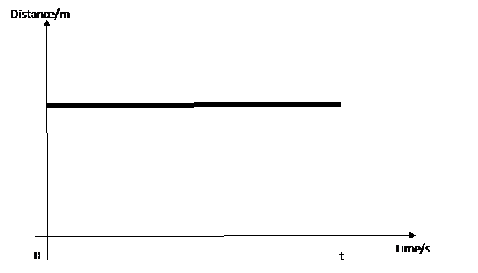
2. Fig 3 below is a distance-time graph that shows an object whose distance travelled is constant form 0 s to time t s. We can thus assume that the object is stationary. The gradient of the graph is thus 0 which means that the speed is also  0 m/s from 0 s to t s. The speed-time graph would thus be as shown in fig 4 below.

clip_image001[8]Fig 3


clip_image001[6]Fig 4

3. Fig 5 below is a distance-time graph that shows an objects moving and the distance travelled is increasing.

The gradient of the graph is the speed. From the graph the gradient is a constant value but is not zero. Hence the speed-time graph is as shown in fig 6.

clip_image001[5]

Fig 5

clip_image001[3]

Fig 6

4. In fig 7 below we have a distance-time graph that shows an object that is moving as a result the distance travelled is increasing.

As we know the gradient of the graph is the speed and since the gradient is increasing then is it means that the speed is increasing. Hence the speed-time graph of the object is as shown in fig 8.

clip_image001[11]

Fig  7

clip_image001[13]

Fig 8

Friday, January 22, 2010

Distance-time graph

The ability to draw graphs and to obtain information from them is one of the most important skills that a physicist needs to develop. You are also able to extract information more easily using graphs.

Example 1

A boy starts to walk at t = 0 s and walks from point A to point B a distance of 100 m for 10 s . He then stops and walk back towards his starting point in a time of 10 s.  The motion is as shown in fig 1.


clip_image002[4]

Fig 1

If you use a table to present this information then it would be as follows:

time /s

Distance travelled /m
0 0
10 100
20 200

Table 1

After 10 s the boy has walked a distance of 100 m. And after 20 s the boy has walked a distance of 200 m( 100 m from A to B and another 100 m from point B to A).

Hence we can plot this on a graph as shown in fig 2 below.

clip_image002[6]

Fig 2

As you can see from this graph the different coordinates will the give you the distance that the boy has walked after a particular time.

Now that you can plot the motion of an object on a graph. Let us see what you can do with a distance-time graph.

You would remember that the speed of an object is the rate of change of distance with time and that it can be calculated using the following equation

speed = distance travelled / time taken

With the distance-time graph the speed of an object at a particular time is the gradient of the line at that particular point.

Now what is the speed of he object at 5 s?

You will have to determine the gradient of the line at 5 s.

Hence the two coordinates that can be used are

(0,0)  and (10,100)

The gradient is thus

gradient = (y1 –y2)/(x1-x2)

                   = (0-100)/(0-10)

                   = –100/-10

                   10

Hence since the gradient a distance-time graph is the speed

speed at 5 s = 10 m/s

Monday, December 14, 2009

Moment and couple


Moment

We have when earlier that a force acting on an object causes work done. Here we are going to see that if a force act on an object the a rotation can occur.

Let us look at some examples. You will see that if the force act on an object in a certain way the object would undergo a rotation about a centre of rotation.

Example 1

clip_image001

In this example a footballer would kick the ball and the ball would rotate about the centre of the ball the centre of rotation.

Example 2

clip_image001[10]

In this example a person is opening a door by exerting a force on the door handle. The door will thus rotate about the hinge of the door.

So we can thus say that the moment is related to the turning effect of a force.

We are now going to have look at how the moment of a force is calculated.

clip_image001[12]

In the diagram above we have the force F that is applied on the door handle. 

The force is applied on the handle and the point on the object where the force is applied is called point of application of the force. The distance between the point of application of the force and the pivot is the distance d.

Note that the force must be at right angle to the distance d as shown in the diagram below. If it is not at right angle as shown in the second diagram below then the component of the force that is at right angle to the distance must be determined. In the case of the second diagram below the component of the force that is at right angle to the distance is Fcosθ

clip_image001[16]

clip_image001[12]


We can now return to the diagram shown above, and we can say that the moment can be calculated as shown below.

Moment = Force * perpendicular distance from point of application of the force to the pivot

If the force is at right angle to the distance then

moment = F *d

If the force is not at right angle to the distance then

Moment = Fcosθ*d

          = Fd cosθ


Couple

A couple is when two forces of equal magnitude but acting in opposite direction on an object causing a rotation.

The best example is the car steering wheel or the handle of a motorcycle. As the diagram below shows two forces that are equal to each other in magnitude but acting in opposite direction act on an object. The point of applications of the two forces are separated by a distance d.


clip_image001[18]   Hence the couple can be calculated using the equations below.

Couple = Magnitude of one of the two forces * the distance between the point of application of the two forces

couple = F* d

Of course the same principle  will apply to couple if the forces are not at right angle to the distance. Then the component of the force at right angle to the distance must be used. The couple will then be calculated using the equation

couple = Fd Cosθ

Tuesday, November 24, 2009

Speed and velocity

After distance and displacement that we have seen earlier, I am now going to talk about speed and velocity. They are quite different and to understand them it is important to understand clearly the difference distance and displacement before going forward.


Speed

Speed is a scalar quantity and the unit is the metre per second (m s-1)

A boy moves from point A and walks a distance of 50 m to the point B in a time of 20 s.

clip_image00111_thumb1

Firstly what is the distance travelled in 1 second?

Yes the boy would walk a distance of 2.5 m in a time of 1 second.

The distance travelled in a time of 1 second is called the speed.

The equation to calculate the speed is shown below.

clip_image002


Can you determine the speed of the boy?

clip_image002[6]

Hence whenever speed is calculated the distance should be used.

Velocity

Velocity is a vector quantity and the unit is also the metre per second(m s-1)

Since it is a vector quantity then when it is determined direction is important and hence displacement should be used.

A boy moves from point A to point B performing a displacement of 50 m towards the right as shown in the diagram below.

clip_image00121_thumb

The following equation is used to determine the velocity.

clip_image002[8]

Hence the velocity of the boy can be calculated as shown below.

clip_image002[12]

Please note the difference between the two. For the speed the distance travelled is used while for the velocity the displacement is used.

Distance and displacement

Distance and displacement are two quantities that are used to describe motion. We are going to have a look at both of them and see how to differentiate between the two.

Distance

Distance is a scalar quantity and the SI unit is the Metre (m)

Example 1

clip_image001[11]


Now suppose a person moves from an initial position of A and travels to a final position of B. The line connecting the two points is the path that the person would take. Now the distance travelled is the length of the path taken by the person from the initial position to the final position.

Example 2

clip_image001[9]

Now if the path is not a straight line like in the diagram shown above then the distance travelled is the length of the path  from A to B through all the turns  as measured with a measuring tape.

Example 3

clip_image001[19]

The next example is shown above. The person moves from A to D. The path is a line moving from A to B to C and then finally to D. Then the distance travelled is the length of the path AB+ the length of the path BC + the length of the path CD

Displacement

Displacement is a vector quantity and the SI unit is the metre (m)

The displacement is a vector representing the shortest path from the initial position to the final position. It is thus a vector quantity. Let us have a look at the different motion above and see how the displacement is determined and how it is different from the distance.

Example 4

As we have seen in example 1 above the person moves from the initial position A to the final position B.

clip_image001[21]

As you can see the person moves from the initial position A to the final position B and the vector representing this motion is as shown. And the displacement is represented by this vector. Hence the displacement will have both a magnitude which would be the length of the vector and a direction which would be the direction of the vector.

For example 4 above we can say that the displacement is 10 m to the east.

Displacement = 10 m to the east

or Displacement = 10 m to the right

As you can see the displacement would have both a magnitude and a direction since it is a vector quantity.

Example 5

clip_image001[25]

This is the same motion that we used in example 2. The person moves from the initial position A and travels until he reaches the final position B. As you can see on the diagram above there is a vector from the initial position A to the final position B. This vector represent the displacement of the person where the length of the vector is its magnitude and the direction of the vector the direction of the displacement.

In this case the displacement of the person can be said to be

Displacement = 10 m 15o clockwise from the horizontal,

Where the line AC represent the easterly direction,

Example 6

Now let us look at the same motion example that the person did in example 3. The person walks from A to B to C and finally arrives at D. You can see on the diagram below that I have drawn a vector AD that starts from the point A and ends at the point D. This vector is the displacement vector and as you can see it has a magnitude and a direction.

We can say for example that the displacement is as shown

Displacement = 15 m 150 clockwise from the horizontal

clip_image001[6]

As you have seen displacement and distance are two quantities easy to understand and to differentiate but as usual if you have any question you can leave them here and I would answer then as soon as possible.

Tuesday, July 14, 2009

Work done

Work done is a very important concept in Physics as it is used in fields, in deriving gravitational potential energy and kinetic energy, etc.


So what is work done?


Let us look at the diagram above. A force F acts on the box at A. During the time the force is acting, the box moves in the direction of the force. When the application of the force stopped the box has moved a distance d.


Using the definition

Work done is the product of the force acting on an object and the distance moved by the object in the direction of the force.


We can deduce that the equation to calculate work done is


Work done = Force * distance moved in the direction of the force

Work done = F *d


Let us have a look at an example.

Example


A man pulls a table by exerting a force of 100 N on it moving it by a distance of 3.9 m.

Calculate the work done by the man?


Work done = Force * distance moved in the direction of the force

Work done = F *d

= 100 * 3.9

= 3900 J


If you have understood the concept do the question below.

Question

A braking force of 2.3*104 N is applied to a car and as a result the car stops in a distance of 23 m. Calculate the work done in stopping the train.

Good luck.

Related Posts Plugin for WordPress, Blogger...